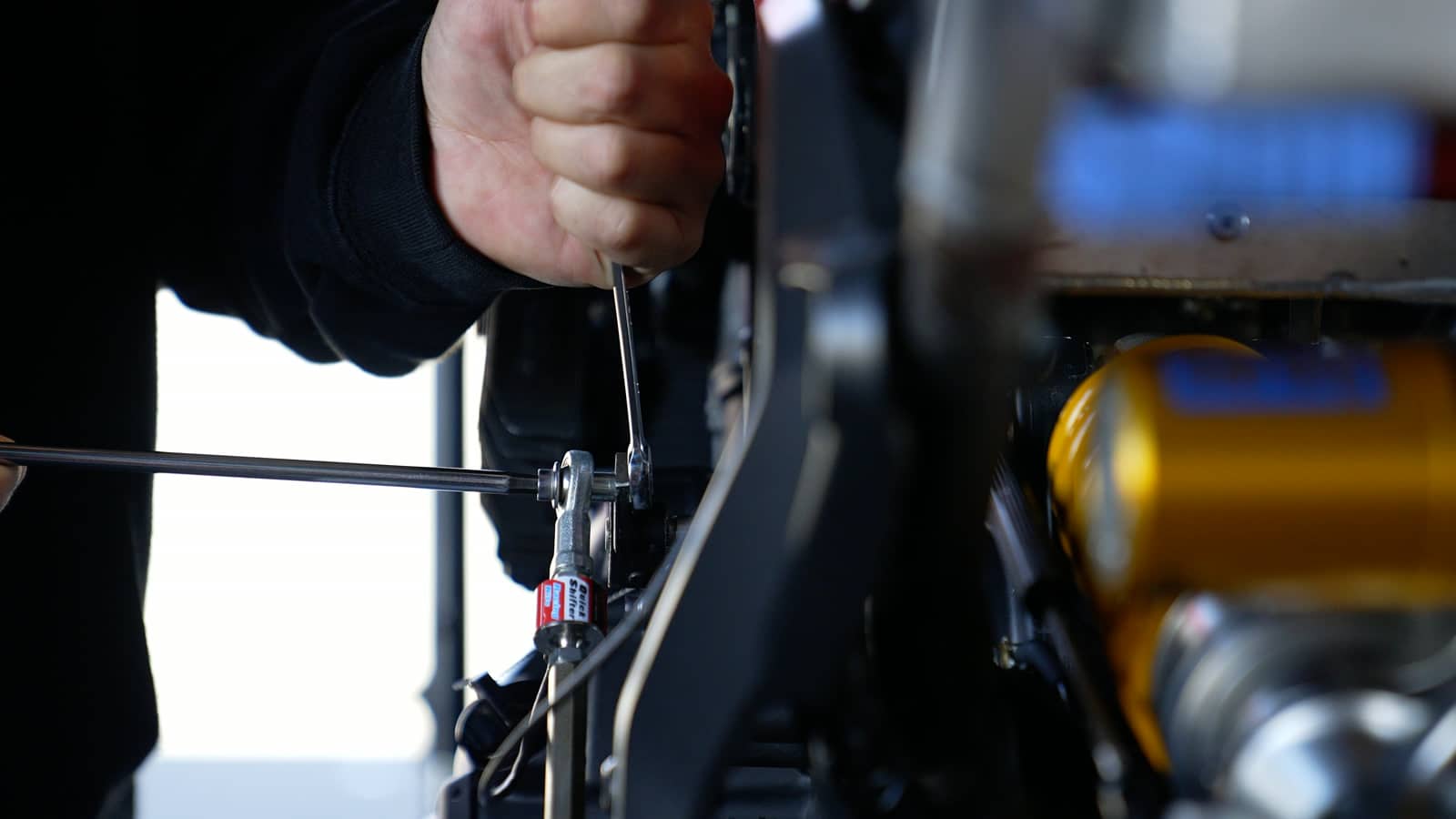
“It’s hard to go fast when you don’t feel confident your bike’s going to go into gear.”
Melissa Paris makes that observation while explaining a mechanical decision in Permission Not Asked. The team does not think the transmission is necessarily the problem. Even so, they plan to swap engines to one with fewer miles and investigate every possible avenue.
It is a short passage, but it says a great deal about her approach. Confidence is connected to preparation. Before the rider can concentrate on going fast, someone has to do the work that makes the motorcycle trustworthy.
Melissa understands both sides. She has been the racer and the mechanic.

The decision behind a short workshop moment
In the film, Melissa describes a process of checking the possibilities rather than declaring that she already has the answer. The engine change is part of that investigation.
It would be easy to turn the clip into a dramatic claim about a failed gearbox. Her actual account is more useful. She says the team does not really think it is the transmission, but they need to be thorough.
That distinction shows the value of listening to her complete explanation. The story is not a miracle repair or a shortcut. It is a professional taking uncertainty seriously and working through it.
This article is about her approach to preparation, not a repair procedure. A short film excerpt cannot replace the specifications, checks, or qualified support a particular motorcycle requires.
More than a bike that is ready
When Melissa talks about work ethic, she sets a higher standard than simply getting a motorcycle onto the track.
She asks whether someone is willing to stay up all night and do what it takes to prepare the best and safest bike they can. That is the standard she says matters to her.
The language is direct because the responsibility is real. Preparation is not only a matter of pride in a finished object. Someone will ride the motorcycle. The quality of the work follows them onto the track.
Her racing experience gives her a perspective on how the machine feels to the person riding it. Her mechanical work gives her a perspective on what it takes to prepare it. In the film, she describes that combination as useful when discussing technical rules and track safety.
Learning to pick up the wrench
Melissa did not begin with every skill she has now. She says she raced for a long time before she started working on the bike herself.

That history helps explain why she enjoyed the building side of Royal Enfield’s Build Train Race program. She helped mentor women as they built race bikes, trained on the track, and prepared to race.
People might have expected the track instruction to be her favorite part. She says she especially enjoyed helping with the build.
She talks about the confidence some women lack when picking up a wrench and the satisfaction of showing them that they can learn. When they cannot figure something out, she wants them to know there are people willing to help.
Her message does not depend on pretending that all mechanical work is easy. It is about making learning approachable and asking for help part of the process.
Knowing when to ask someone else
Melissa’s confidence does not sound like certainty about everything. In another part of the film, she jokes that her first reaction when someone asks her for advice is to wonder why they are asking her.
She is willing to share what she knows. She also points to the many people around her who are willing to share their own knowledge.
That is an important part of the workshop story. Competence includes the ability to recognize a question, find another perspective, and keep learning. A person does not have to know everything before they can contribute something valuable.
It also makes her mentoring more credible. She is not asking new riders or builders to arrive fully formed. She knows how much other people’s help can matter.
A work ethic learned at home
Melissa credits her parents with modeling hard work. Her mother drove a bread truck and her father fixed boilers. She remembers seeing them work hard at jobs that were not necessarily their dreams.
For her, getting to work in a sport she loves creates another reason to put in the effort. She does not describe passion as a substitute for work. It is part of why she is willing to do the work.
She also resists the idea of a perfect finished bike. In the film, she says she looks at what she has built and sees things she could have done better or would do differently next time. She values being around people who keep looking for those improvements.

The mechanic is part of the whole story
Melissa introduces herself as a team owner, crew chief, and mother. Later, she lists the many jobs that come with running a small racing business, from mechanic to truck driver to accountant.
She is equally clear that she does not manage those responsibilities alone. Her husband and a wider group of people support her. The film gives her room to recognize that help alongside her own effort.
That makes the workshop footage more than a collection of motorcycle details. It shows one part of a life built around racing, shared knowledge, practical responsibility, and other people.
Watch Permission Not Asked for Melissa Paris’s full story, including the MotoGP opportunity, the work behind the bikes, and the young riders she wants to help.