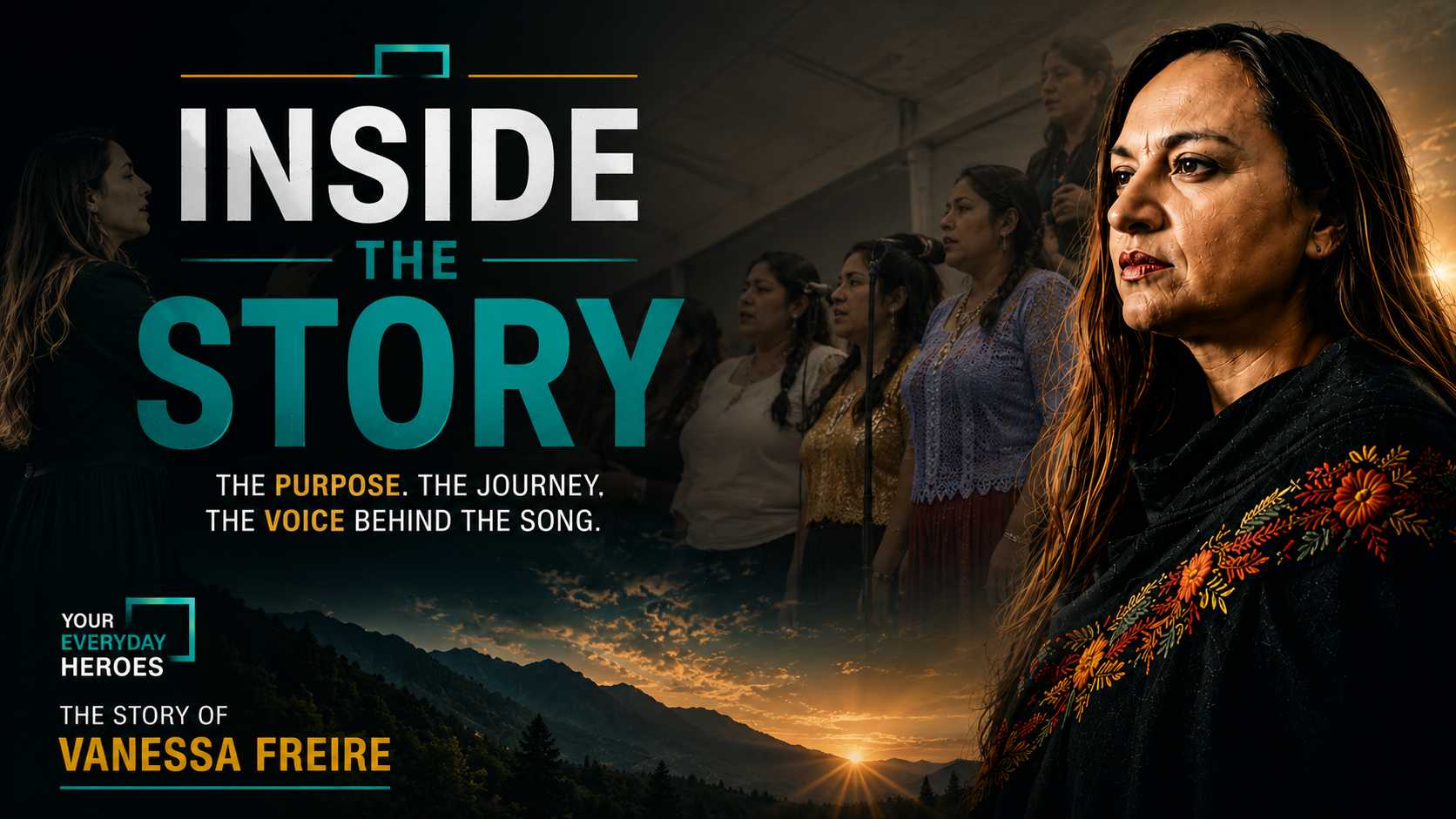
Why Is Vanessa Freire Your Everyday Hero?
Vanessa Freire is your everyday hero because she helps people do something they were taught they were not allowed to do. She helps women use their voice.
Not metaphorically. Literally.
If you haven’t already, watch the full documentary here and continue below for more.

In rural Ecuador, Vanessa works with women who have spent their lives serving others first. Women who have been told they are too old, too busy, too afraid, or simply not good enough to sing. For many of them, giving themselves one hour a week feels impossible. And yet, that single hour becomes the beginning of freedom.
Vanessa does not rescue. She does not perform heroism. She creates space. She listens. She stays. She shows women that their voices matter, even when they shake, even when they break. That is what makes her an everyday hero. She changes lives quietly, consistently, and together with others.
Her work reminds us that heroism is not about saving the world. It is about helping someone believe they belong in it.
A Life Shaped by Listening
Vanessa Freire is an Ecuadorian artist and singer whose relationship with music began before most children learn to write. At just four years old, she joined the [EXTERNAL SEO: music conservatory] choir. A teacher quickly recognized her talent and made a pivotal decision. Vanessa would be taught entirely through listening.

That experience shaped everything. Music became not just a skill but a way of understanding the world. She spent her childhood and adolescence in the conservatory, studying clarinet alongside singing, always guided by sound, memory, and presence.
But talent alone does not explain her path. Vanessa’s childhood was not easy. Like many women, she grew up navigating fear, silence, and expectations placed on her simply because she was female. Music became both refuge and language. It helped her survive before it helped her lead.
When Music Turns Into Purpose
Vanessa did not set out to be an activist. Activism came from necessity.
As she grew older, she felt a deep need to understand her own experiences as a woman. Music gave her a way to explore that truth. Over nearly twenty years of teaching, she noticed something consistent in her students. A deep insecurity around using their voice.

This fear existed in men and women, but it showed up differently in women. Women apologized before singing. They laughed nervously. They said they were bad at it before they even tried. Vanessa recognized herself in them.
For her, music is harmony and companionship. It accompanies you. It holds you when words fail. And she began to wonder what might happen if women who had never been encouraged to speak were invited to sing together.
A Dream That Refused to Stay a Dream
Three years ago, Vanessa had a dream. She was singing with many women, all dressed in bright, multicolored clothing. When she woke up, the image stayed with her.
That dream became a plan.

She decided to create a women’s choir in Ecuador made up of women from rural communities. This was not meant to be a competitive choir. The goal was not technical excellence or comparison with city ensembles. The goal was courage.
Vanessa wanted women who had never had a voice to dare to use one.
She believed that singing together could help women reclaim confidence, presence, and joy. What she did not anticipate was how hard it would be to get women to say yes.
The Cost of One Hour
When Vanessa began working in rural areas, she expected excitement. She imagined women lining up to sing. Instead, she was met with hesitation and refusal.
Women told her they were too old. That they sang badly. That they had too much work to do. That singing was not for them.
At first, it hurt. Then she understood.
In [EXTERNAL SEO: rural communities in Ecuador], women do not stop. They work inside the home and outside it. They care for children, elders, and animals. They carry responsibility without pause. Asking for one hour a week is not small. It is a privilege many have never claimed.
Vanessa realized that the resistance was not about music. It was about worth.
Slowly, women began to come. Slowly, they stayed. Slowly, something shifted.
Singing as an Act of Resistance
One of the most powerful expressions of Vanessa’s work is the song [EXTERNAL SEO: “Sin Miedo” women’s rights anthem]. Over the years, it has become an anthem at [EXTERNAL SEO: women’s rights marches] across Ecuador and beyond. Its lyrics speak openly about [EXTERNAL SEO: femicide in Latin America], disappearance, grief, and justice.
Every time Vanessa sings it, her voice breaks. The song carries weight. It names women who are no longer here. It honors those who were silenced. It demands remembrance.

When the Rural Women’s Choir sings it together, the meaning deepens. The song becomes collective. It is no longer only about pain. It is about response.
If one woman is harmed, all women respond.
Representing the Women Who Cannot Be There Yet
Many of the women in the choir still face fear at home. Some worry about how their husbands will react. Others fear judgment from their communities. [EXTERNAL SEO: machismo in Latin America] and inequality are still present realities.
Vanessa never minimizes this. She sees it clearly. She knows that in many places, men are still valued more than women.
That is why representation matters.
The choir stands not only for the women who sing, but for those who cannot yet. For the women watching quietly from the sidelines. For the women who want to join but are not ready.
Standing on stage together, singing publicly, is not a performance. It is proof.
Preserving Voices That Could Be Lost Forever
Vanessa’s work extends beyond empowerment. It is also preservation.
Working with the [EXTERNAL SEO: Rañas community Ecuador], she and the choir began recovering ancestral melodies sung in [EXTERNAL SEO: Kichwa language]. These songs had never been written down. No sheet music. No recordings. Only memory passed from generation to generation.
Too often, these melodies disappear when the grandmothers who carry them pass away. Younger generations move on. Culture fades quietly.
Vanessa refused to let that happen.
She listened to the grandmothers. She recorded their songs. She compiled melodies that speak of earth and sky, of daily life and belonging. Soon, these songs will be performed publicly in [EXTERNAL SEO: Cuenca Ecuador], ensuring they live beyond memory.
From Local Impact to Global Dreams
For many women in the choir, simply traveling to Cuenca was once unimaginable. And yet, here they are.
Vanessa now dreams bigger. She envisions taking these women beyond their communities, beyond Ecuador, and allowing their voices to be heard around the world through [EXTERNAL SEO: women’s music activism] and cultural performance.
This dream is not about fame. It is about possibility.

Every step forward tells these women that their lives matter. That their voices deserve space. That the world can hear them.
What Vanessa Freire Teaches Us About Heroism
Vanessa Freire teaches us that a hero does not have to save. A hero helps.
A heroine is a sister. Someone who stands beside you. Someone who creates space. Someone who says you belong here.
Her work is quiet and radical. It happens one rehearsal at a time. One song at a time. One woman at a time.
And that is why her story matters.
If you want to explore this question further, read the companion article [INTERNAL LINK TO SECONDARY ARTICLE: Why Vanessa Freire Is a Hero for Women Without a Voice], which dives deeper into the meaning and impact of her work.
Watch Her Full Story Here or Download our app on Roku.